
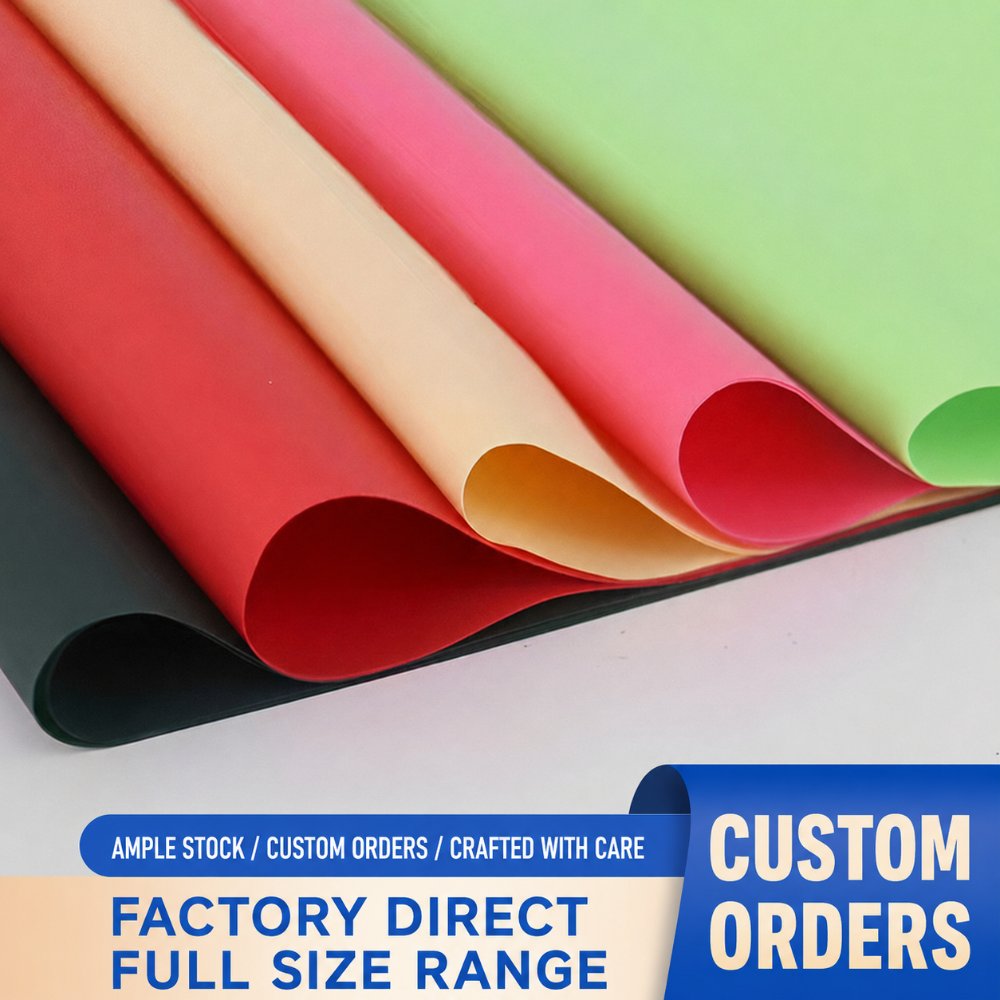
Approve a coloured film sample against an identified physical reference and an agreed viewing record, rather than a screen image alone. Ask the supplier to link each offered colour and finish to a sample identifier. Keep material identity and dimensional requirements in separate fields, so a visual approval cannot accidentally become acceptance of an unconfirmed product specification.
Use the product page to open the discussion
Youchuang’s PEVA film listing shows coloured film and describes colour and finish options. The photograph is useful for discussing an assortment, but it does not establish an exact colour standard or the identity of every material offered. The page also uses differing material wording across its title and specification area. Ask the supplier to reconcile that wording for the proposed item instead of choosing whichever label seems most convenient.
Start the enquiry with the exact product link, a buyer reference and the visual characteristic you want to discuss. If several shades are required, give each its own line. Avoid a request such as assorted colours unless the supplier is also asked to explain how the assortment will be selected. A photograph containing several sheets does not prove that every pictured colour is currently available or included in one order.
Identify the reference before comparing shades
A colour reference needs an identity that remains attached to the sample. Record who supplied it, when it was received and which proposed item it represents. If your team has an existing physical reference, ask whether the supplier is matching that reference or offering its nearest catalogue option. Those are different decisions and should not be merged into one word such as matched.
Make viewing conditions part of the review note. Record the lighting arrangement and the background used to examine the sample, particularly when appearance changes with what sits behind the film. This is a practical comparison record, not a claim that a particular laboratory method was performed. Any instrument measurement, acceptance tolerance or formal test must be separately specified and supported by the relevant result.
Sample record | What to write | What not to assume
Colour identity | Buyer shade reference and supplier sample ID | Screen image is an exact standard
Viewing setup | Lighting and background used | All viewing conditions look identical
Finish description | Observed face and proposed supplier term | A photograph defines a measured finish
Material identity | Supplier confirmation for this sample | Every catalogue label is interchangeable
Approval scope | Appearance fields accepted and fields pending | Visual approval accepts all specifications
Keep finish and transparency questions separate
Ask which face of the film should be used for the appearance comparison and whether the offered sample has any intentional difference between its faces. Describe what your reviewer actually observes rather than assigning an unsupported technical finish. If an appearance is important to the intended design, provide a marked reference and ask the supplier to explain how its proposed sample compares.
Colour and visibility through a sheet can influence each other. Record whether your team viewed the film alone or against another object, and ask the supplier to use the agreed presentation when supplying comparison photographs. Do not convert an informal description such as opaque or semi-transparent into a measured specification without an agreed criterion. The catalogue wording can guide the question; it cannot supply the missing acceptance method.
Define what a sample approval actually releases
A purchasing team should be able to see exactly what was approved. An appearance approval may cover a named shade and the selected face while leaving thickness, width, composition, quantity and delivery terms unresolved. List those boundaries in the same record. This prevents an attractive colour sample from being treated as blanket approval for a different material, presentation or commercial offer.
If a sample is rejected, describe the difference in terms the supplier can act on. Link the comment to the relevant sample identifier and viewing record. Ask for a new revision rather than allowing an unlabelled replacement to circulate. Keep the rejected reference available until the revised sample has been compared, so the team can confirm that the intended issue was addressed.
• Give each colour its own buyer reference and supplier sample identifier.
• Record the face, background and viewing arrangement used for the appearance decision.
• Separate approved visual fields from unconfirmed material and dimensional fields.
• Require a new revision identifier when the supplier changes the sample.
Carry the accepted reference into the quotation
Connect the accepted sample to the quotation line that purchasing will use. Ask the supplier to name the offered item, state whether the price is tied to that reference and identify any differences between the sample and proposed production. If an assortment contains several colours, make the requested allocation explicit and ask the supplier to confirm its quotation basis rather than assuming an equal split.
Before placing an order, check that the latest sample record and quotation describe the same proposed material. Do not copy unsupported safety, environmental, waterproofing or certification statements from the website into your approval. Requirements for a specific use should be stated as questions and supported by item-specific evidence. The purpose of the colour record is to make one visual purchasing decision traceable while keeping every other decision honest and visible.
Frequently asked questions
Can the website photograph be the only colour standard?
It can identify the catalogue item being discussed. Use an agreed physical sample or another explicitly accepted reference for a purchasing decision that needs a reproducible shade comparison.
What if the title and material field use different names?
Ask the supplier to confirm the composition and identity of the exact sample offered. Preserve the ambiguity until the reply resolves it; do not silently substitute one name for another.
Does approving a colour accept the film for every application?
No. Record the scope of the visual approval and keep application requirements, material identity, dimensions and any required evidence as separate decisions.
Product and contact references
Catalogue reference: confirm matching item: https://wzycxcl.com/product/product/
Related catalogue reference: https://wzycxcl.com/product/product-2/
Contact Youchuang New Materials: https://wzycxcl.com/contact/
Youchuang New Materials blog: https://wzycxcl.com/blog/